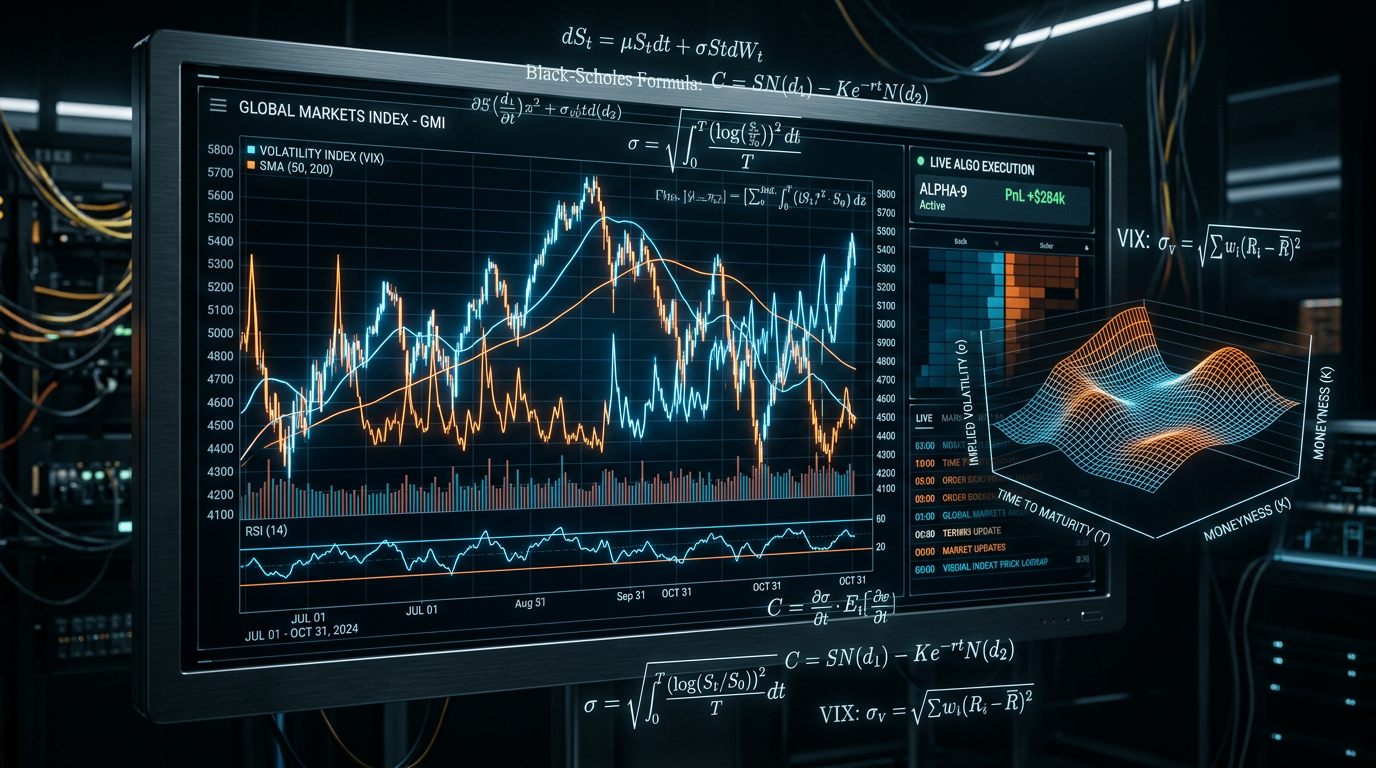
GARCH (Generalized Autoregressive Conditional Heteroskedasticity) models offer quantitative traders a powerful statistical edge for predicting the dynamic, time-varying volatility of the Nifty 50 index. By leveraging this advanced mathematical approach, traders can build more adaptive intraday strategies, dynamic stop-losses, and highly accurate options pricing models for the Indian equity markets.
The Flaw In Standard Volatility
Most retail traders rely on traditional volatility indicators like the Average True Range (ATR) or standard Bollinger Bands. These tools assume that market volatility remains constant over time or simply average out past price ranges. However, financial markets behave non-linearly, meaning yesterday's sudden market crash will heavily influence today's price swings. Relying on simple historical averages often leads to premature stop-loss hits or missed targets in fast-moving intraday environments.
Understanding GARCH Mechanics
The GARCH model resolves the limitations of standard indicators by treating volatility as a dynamic, mean-reverting process. It calculates current volatility based on a combination of long-term variance, previous day's volatility, and recent market shocks (price returns).
This ensures that recent, massive spikes in the Nifty index heavily weight the forecast for the upcoming trading session. A standard GARCH(1,1) model ensures that massive spikes in the index heavily weight the forecast for the next session.
Spotting Volatility Clustering
A core phenomenon that GARCH captures perfectly in the Nifty 50 is volatility clustering. This refers to the market tendency where large price changes are frequently followed by large price changes. When Nifty experiences a gap-down or massive sell-off, GARCH instantly recalculates a higher volatility regime for the next few periods. This allows algorithmic systems to widen their target ratios and avoid mean-reversion trades during euphoric or panic states.
The Asymmetric Leverage Effect
Indian equity markets frequently exhibit an asymmetric response to news, meaning negative shocks increase volatility much more aggressively than positive shocks of the same magnitude. Advanced variations like EGARCH (Exponential GARCH) are specifically designed to capture this leverage effect. When a bearish catalyst hits the Nifty, these models adjust the expected variance curve higher, preventing algorithmic systems from taking long positions too early.
PointAlgo Strategy Implementation
Integrating GARCH-based proxies into TradingView or AmiBroker provides a massive advantage for 5-minute Nifty intraday trading:
- Dynamic Targets: Adjust your reward-to-risk (RR) ratios based on the projected daily variance.
- Noise Filtering: Stop losses can be placed safely outside the GARCH-predicted noise band to avoid getting hunted.
- Regime Detection: Know exactly when to switch from mean-reversion logic to trend-following breakout systems.
Institutional Tools
For complex custom indicators and institutional-grade trading algorithms for Nifty and other Indian indices, explore the proprietary tools developed at PointAlgo.
View Pro Strategies